
What LCC Students Need to Know About the One Big Beautiful Bill Act (OBBBA)
Signed into law on July 4, 2025, the “One Big Beautiful Bill Act,” also known as Working Families Tax Plan or Working Families Tax Cuts, makes major updates to federal student aid. Many changes begin July 1, 2026. The Financial Aid Office will update this page as new details are released.
Key Updates
- New federal loan limits and repayment options go into effect July 1, 2026
- Annual Federal Direct Subsidized and Unsubsidized Loan limits remain unchanged
- Students may not receive more than half of their full-time annual loan limit in a single semester
- Federal Parent PLUS Loan borrowers are subject to new annual and aggregate lifetime loan limits
- Schedule of Reductions (SOR) calculation is required for students enrolled less than full-time; dropping and withdrawing from classes will impact the loan calculation
- Standard Repayment Plan remains in place
- The new Repayment Assistance Plan (RAP), is replacing all current income-driven repayment (IDR) plans
Loan Limits
Starting with the 2026-2027 academic year, Federal PLUS Loans for undergraduate students will be subject to new borrowing limits (this is per dependent student):
- $20,000 maximum per academic year
- $65,000 lifetime (aggregate) limit
Once the aggregate limit is reached, parents will no longer be eligible to borrow Parent PLUS Loan funds for the dependent student.
Federal Student Aid Schedule of Reductions
Effective as of the 2026-2027 award year, federal regulations require a Schedule of Reductions (SOR) calculation for Federal Direct Loans. The regulation states how annual loan limits are calculated for students enrolled less than full-time. Federal Direct Loans include both Subsidized and Unsubsidized Loans.
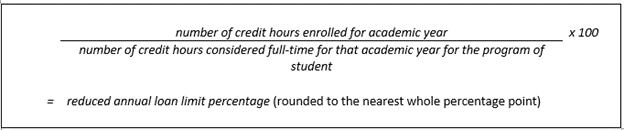
Under these regulations, students enrolled less than full-time in credits required for their program of study for the academic year will have their annual loan eligibility reduced based on their actual enrollment level. Full-time for the academic year is defined at LCC by 24 credits over 32 weeks (Fall and Spring semesters); full-time enrollment for one semester is 12 or more credits. This means the maximum loan limit will be adjusted in proportion to the number of credits in which the student is enrolled. Students who begin the semester enrolled full-time but subsequently drop or withdraw from any courses, resulting in enrollment below 12 credit hours, will also be considered less than full-time for the purposes of these regulations.
If a student changes their enrollment status during the academic year—including dropping or withdrawing from courses—any remaining (future) loan disbursements in the academic year will be recalculated to reflect the updated enrollment level. For example, if a student begins the semester as full-time and later withdraws from a course, future semester disbursements may be reduced to ensure the total annual loan amount does not exceed the allowable limit for the student’s revised enrollment status.
These changes are intended to align borrowing limits more closely with a student’s academic workload and expected progress toward degree completion.
Federal Direct Loan amounts will be determined based on several factors, including the student’s enrollment level, grade level, dependency status as indicated on the FAFSA, estimated cost of attendance, other financial assistance, and the student’s eligible annual loan limit at the time the Financial Aid Office processes the loan(s). This ensures that loan amounts reflect both federal limits and the student’s specific academic situation.
If a student’s enrollment changes after a loan has been originated, the loan amount will be recalculated to reflect the updated enrollment level up to the time of disbursement to the student. Loan recalculations should be completed within 24–72 business hours. However, increased volume during peak processing periods, such as payment due dates, the start of a semester, course drop deadlines or disbursement dates, the recalculations and loan adjustments may take longer than 72 business hours. This process ensures that loan amounts accurately align with the student’s current enrollment status to the fullest extent possible.
If a student drops or withdraws from any course, any remaining future loan disbursement in the academic year will be recalculated to reflect the updated enrollment level and will not exceed the allowable limit for the student’s revised enrollment status for the academic year.
If a student adds courses after a loan disbursement has been made to the student and the student wishes to request additional loan funds, they must submit a Loan Form for the applicable aid year to apply for the increased amount. A link to the Loan Form is on the LCC Financial Aid web page.
How much of my loan will I get?
Loan eligibility is awarded by semester as a percentage of your annual loan limit:
- Students enrolled in 12 or more credits required for their program of study in a semester are eligible for 50% of the annual loan limit for that semester.
- For students enrolled in fewer than 12 credits required for their program of study, eligibility is prorated as follows:
| Undergraduate Enrollment (per semester) |
Percent of Annual Loan Limit | Example loan amount for a Dependent Freshman student (per semester) |
|---|---|---|
| 12+ Credits | 50% | $2,750 |
| 10 Credits | 42% | $2,310 |
| 9 Credits | 38% | $2,090 |
| 8 Credits | 33% | $1,850 |
| 7 Credits | 29% | $1,595 |
| 6 Credits | 25% | $1,375 |
| 1-5 Credits | 0% | $0 |
*Loan amounts in this example are based on $2,750, which represents one semester of eligibility for a dependent freshman student with a $5,500 annual loan limit. These are estimated amounts provided for illustration purposes only. Actual loan amounts may vary and are subject to origination fees or other applicable loan reductions.
By accepting your loan, you acknowledge that you understand these enrollment requirements and how they may impact your loan eligibility.
Your loan amount is based on the number of credits you are taking at the time funds are disbursed. If you add, drop, or withdraw classes, your loan eligibility may change. You are responsible for reviewing your schedule and understanding how enrollment changes may affect your financial aid. If you reduce your enrollment after receiving funds, you may be required to repay a portion of your loan. Please contact the Financial Aid Office if you have questions about your loan eligibility prior to making registration changes. The Financial Aid Office can be reached at 517-483-1200 (option 1 on the menu) or financialaid@star.lcc.edu.
Please note:
- Lansing Community College does not have the ability to grant exceptions to federal regulations, including those concerning enrollment or federal loan eligibility.
- This information is based on the current understanding of new rules and regulations as they relate to federal student financial aid, and could change with little notice. We will update and add to this page as additional guidance is received from the U.S. Department of Education.
Frequently Asked Questions
What is changing beginning with the 2026-27 academic year?
Federal Direct Loans will be subject to Schedule of Reductions (SOR), also known as annual loan limit proration, for students enrolled less than full-time for the academic year. Loan eligibility may be reduced based on the student's annual enrollment level.
What is the definition of full-time for the academic year at Lansing Community College?
Full-time at Lansing Community College is defined as 24 credits over 32 weeks (Fall and Spring semesters); full-time enrollment for one semester is 12 or more credits.
What if the student is in a program that requires Summer enrollment?
Full-time enrollment for a student in a program of study that requires attendance during Summer semester is defined as at least 12 credit hours Fall semester, at least 12 credit hours Spring semester, and at least 12 credit hours Summer semester equaling 36 credit hours for the academic year.
If a student enrolls in courses not required for their declared program of study in order to have 12 or more credits, are they considered full-time for Federal Direct Loans?
No. Only courses required for the student’s program of study and financial aid eligible credits are considered in the SOR calculation for Federal Direct Loans. Prior rules about financial aid eligible credits remain in place, such as repeated courses and remedial credit limits. This means some courses required for a student’s program could still be considered ineligible for the SOR calculation.
Which students are affected by this change?
Students whose enrollment level for the academic year is less than full-time may be subject to reduced annual loan limits. This applies to new loan originations for the 2026-27 academic year and beyond.
How is annual enrollment level determined?
Annual enrollment level is based on the total number of credits a student is expected to complete during the academic year divided by the number of credits required for full-time enrollment.
Can a student's loan eligibility change during the year?
Yes. If a student adds, drops, or withdraws from classes, their annual enrollment level changes, which could impact their loan eligibility and future disbursements.
Will students who start full-time and later drop below full-time be affected?
Potentially. Enrollment changes may require the institution to review the student's loan eligibility and determine whether adjustments to future loan disbursements are necessary.
What happens if a student increases their enrollment after a loan has been reduced?
The Financial Aid Office may review the student's eligibility and determine whether additional loan funds can be awarded, provided the student remains otherwise eligible and annual limits have not been reached.
Can enrollment during a semester the student is not eligible for Federal Financial Aid be considered in the SOR calculation?
No. Any credits a student takes for periods of enrollment that they are ineligible for Federal Financial aid cannot be used for the full-time enrollment calculation. For example, if a student is not meeting Satisfactory Academic Progress (SAP) during the fall semester and is enrolled in 12 credits, then the student regains SAP eligibility for the spring semester and is enrolled in 10 credits, only the credits for spring are used to calculate full-time for the academic year (10 credits in the semester divided by 24 credits in the academic year) to determine the loan amount for spring semester.
Are graduating students still subject to loan proration rules?
Yes. Existing loan proration requirements for students enrolled in programs shorter than an academic year or for students graduating with a remaining period shorter than an academic year continue to apply. Schools may need to evaluate multiple proration requirements when determining eligibility.
What is the most important message for students?
Enrollment matters. Adding, dropping, or withdrawing from courses can affect Direct Loan eligibility, so students should consult Financial Aid before making enrollment changes.
StarZone
The StarZone is home to many student service departments such as admissions, academic advising, financial aid, student finance, testing and more! Visit the Enrollment Support Specialists in the StarZone for help with admissions, class registration, general financial aid questions and more.

Phone: 517-483-1200
Toll Free: 800-644-4522
Fax: 517-483-9668
Downtown Campus
Gannon Building
411 N. Grand Ave
Lansing, MI 48933
Other Contacts
Registrar's Office
Phone: 517-483-1200 option 2
Email: registrar@lcc.edu
Online Chat
Financial Aid
Phone: 517-483-1200 option 1
Email: financialaid@lcc.edu
Academic Advising
Phone: 517-483-1200 option 4
Email: eadvising@lcc.edu
Testing Services
Phone: 517-267-5500
Email: lcc-testing-services@lcc.edu