
Overview
The Radiologic Technology Program is a twenty-two month (five sequential semesters) course of study leading to an associate's degree. Students are admitted in the fall, with a limited number of openings each year. Graduates will be eligible to take the national registry examination administered by the American Registry of Radiologic Technologists (ARRT). Not all courses in this program transfer to all colleges. Students planning to transfer should see an academic advisor before enrollment in any courses.
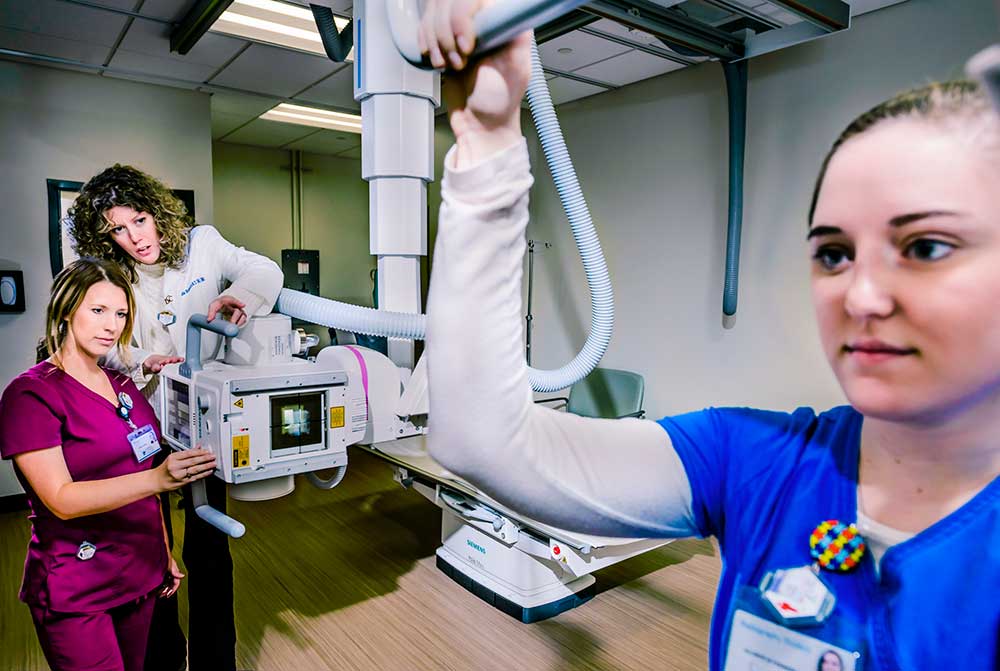
As part of the educational training students receive hands-on experience from available clinical sites (hospitals).
The Associate Degree Program in Radiologic Technology is conducted by Lansing Community College as a contribution to the health education needs of the community whom it serves. Resources provided by the College, cooperating community hospitals, and other health agencies are utilized in the basic Radiologic Technology Program. The qualified student is provided with educational opportunities in a college environment, and shares the intellectual and social responsibilities, privileges, and experiences with college students in other disciplines.
Within this framework, the faculty and administrators assumes responsibility for planning, supervising, and evaluating selected learning experiences. These experiences are developed to meet established objectives, College requirements for the Associate Degree in Applied Science, and eligibility to write the registry examination as established by the American Registry of Radiologic Technologists along with the American Society of Radiologic Technologists who establish curriculum guidelines.
Further, the Faculty believes that Radiologic Technology is a health service, shared with other health disciplines, which has a basic responsibility for promoting health, conserving life, and assisting the individual to achieve an optimum health status and self sufficiency. As a member of the patient oriented team, the radiologic technologist utilizes basic knowledge and skills which contribute to patient care and diagnostic needs.
Lansing Community College's Radiologic Technology program is accredited by the Joint Review Committee on Education in Radiologic Technology.
Clinical Rotations
Delivery of imaging services has undergone significant changes over the past several years and these services are indeed a 24/7 service. Because of our program's clinical education centers being located in a variety of different counties around the Lansing area, students must have dependable transportation to any assignment. Students may expect to drive for up to an hour or more to reach a clinical site. Students will be assigned to two (2) different clinical education centers during their time in the program. During the student's summer and 2nd year fall and spring semesters a maximum of 25% of their total clinical hours may be spent in an evening and/or weekend assignments. A student's combined didactic and clinical contact hours will not exceed 40 hours per week. Additional information regarding clinical rotations will be given to students during their program orientation.
Accreditation
Program Accreditation
The program has been accredited since 1975 by:
Joint Review
Committee on Education in Radiologic Technology (JRCERT)
20 N Wacker Drive
Suite 2850
Chicago, IL 60606-3182
Email: mail@jrcert.org
The program’s current award is 8 years (5 years + 3 year extension). Awarded in 2021
and is due for review in 2029. General program accreditation information and the current
accreditation award letter can be found directly on the JRCERT website.
Radiography Program Effectiveness Data
The following is the most current program effectiveness data. Our programmatic accreditation agency, the Joint Review Committee on Education in Radiologic Technology (JRCERT), defines and publishes this information. The information can be found directly on the JRCERT website.
Credentialing Examination: The number of students who pass, on the first attempt, the American Registry of Radiologic Technologists (ARRT) certification examination, or an unrestricted state licensing examination, compared with the number of graduates who take the examination within six months of graduation. The five-year average benchmark established by the JRCERT is 75%.
| Credentialing Examination Rate | Number passed on 1st attempt divided by number attempted within 6 months of graduation |
|---|---|
|
Year |
Results |
| Year 1 - 2020 | 11 of 11 - 100% |
| Year 2 - 2021 | 12 of 12 - 100% |
| Year 3 - 2022 | 11 of 13 - 85% |
| Year 4 - 2023 | 15 of 15 - 100% |
| Year 5 - 2024 | 14 of 14 - 100% |
| Program 5-Year Average | 63 of 65 - 96.92% |
Job Placement: The number of graduates employed in the radiologic sciences compared to the number of graduates actively seeking employment in the radiologic sciences within twelve months of graduating. The five-year average benchmark established by the JRCERT is 75%.
| Job Placement Rate | Number employed divided by number actively seeking employment within 12 months of graduation |
|---|---|
|
Year |
Results |
| Year 1 - 2020 | 11 of 11 - 100% |
| Year 2 - 2021 | 12 of 12 - 100% |
| Year 3 - 2022 | 13 of 13 - 100% |
| Year 4 - 2023 | 15 of 15 - 100% |
| Year 5 - 2024 | 14 of 14 - 100% |
| Program 5-Year Average | 65 of 65 - 100% |
Program Completion: The number of students who complete the program within the stated program length. The annual benchmark established by the program is 75%.
| Program Completion Rate | Number graduated divided by number started the program |
|---|---|
|
Year |
Results |
| Year 1 - 2024 | 14 of 17 |
| Annual Completion Rate | 82.35% |
Goals and Student Learning Outcomes
Upon completion of the Radiologic Technology Program at Lansing Community College all graduates will have met the following program goals:
Goal #1 - Students will be clinically competent.
Student Learning Outcomes
#1 Students will follow through on assigned work and patient care within a reasonable
time frame in the clinical setting.
#2 Students will avoid repeating same positional/technical errors within clinical setting.
Goal #2 - Students will demonstrate appropriate critical thinking and problem solving skills.
Student Learning Outcomes
#1 Students will demonstrate critical thinking skills by manipulating technique from
standard protocol as needed to accommodate various circumstances (size, pathology,
age, etc.) within the clinical setting.
#2 Students will be able to modify radiographic exams and technical factors when warranted in the didactic lab settings.
Goal #3 - Students will communicate effectively.
Student Learning Outcomes
#1 Students will consider the patient's needs, both physical and emotional, and respond
as appropriate for age.
#2 Students will demonstrate the ability to properly identify and interview patients to obtain history and provide explanation of exam as appropriate for age.
Goal #4 - To develop a student who has the ability to establish effective professional relationships with colleagues, patients and their families.
Student Learning Outcomes
#1 Students will maintain a professional appearance by conforming to dress code as established
by clinical site and maintain a well-groomed appearance.
#2 Students will report promptly as scheduled, on time and ready to begin at start of shift avoiding frequent absences.
Goal #5 - Students will successfully pass ARRT Examination.
Student Learning Outcomes
#1 Students will successfully pass ARRT Examination on first attempt.
Goal #6 - To provide students with resources that will contribute to successful job placement as an entry-level radiologic technologist.
Student Learning Outcomes
#1 Students will be employed within twelve months post-graduation.
Related Links
Radiologic Technology Program Related Links
- Michigan Society of Radiologic Technologists
- American Society of Radiologic Technologists (ASRT)
- ASRT Student Services
- Occupational Outlook Handbook
- United States Department of Labor - Bureau of Labor Statistics
- Radiologic Technologists (RT)
- Occupational Employment Statistics
- Magnetic Resonance Imaging Technologists (MRIT)
- Computed Tomography (CT)

Contact Us
Radiologic Technology/MRI Program
Health and Human Services Division Office
HHS Building, 108
517-483-1410
517-483-1508 fax